 ViranInfoSolutions
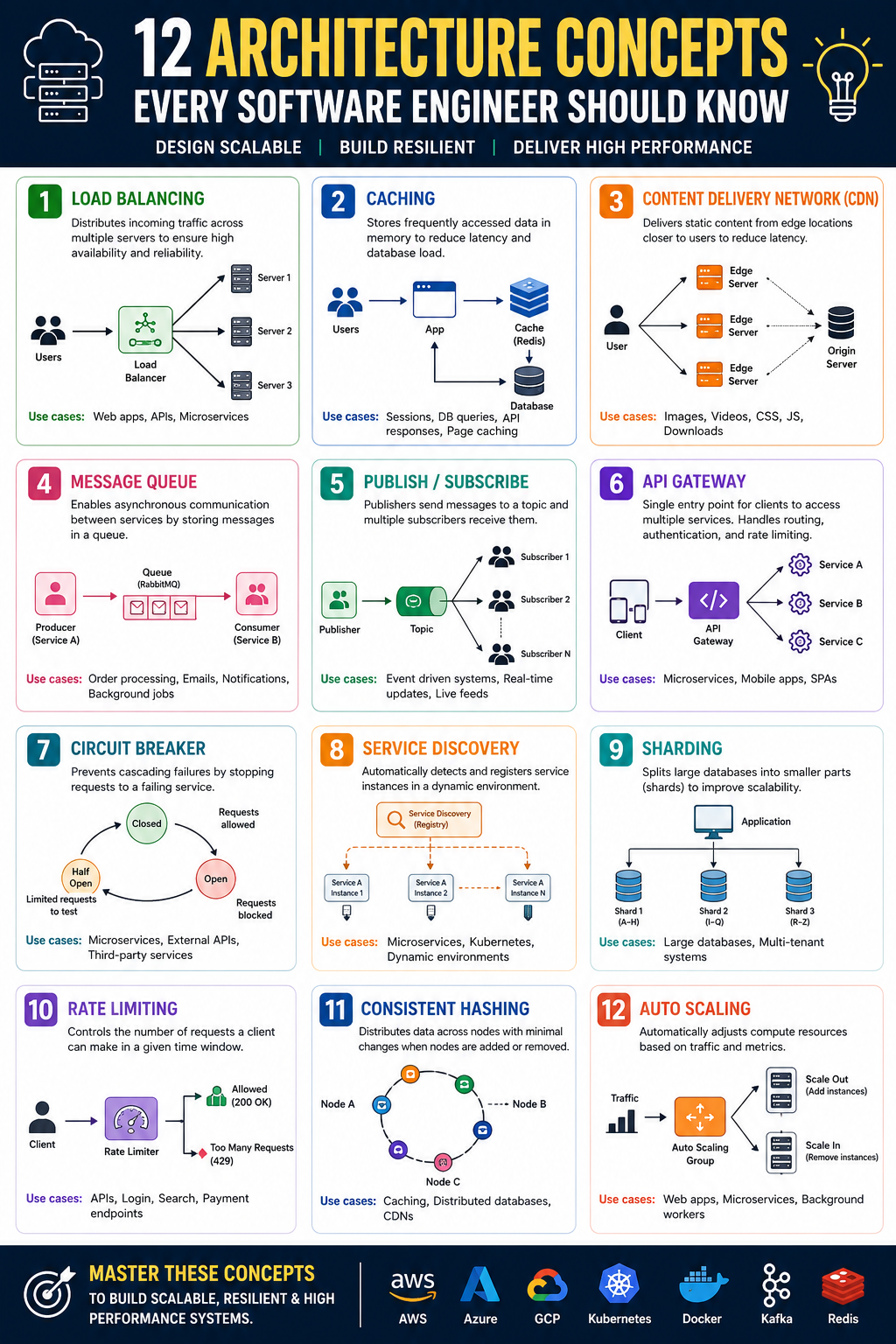
Whether you're a Software Engineer, Full Stack Developer, Technical Lead, Solution Architect, or DevOps Engineer, these 12 architecture concepts are fundamental to modern distributed systems.
1. Load Balancing
Distributes traffic across multiple servers to improve availability and eliminate single points of failure.
2. Caching
Stores frequently accessed data in memory (Redis/Memcached) to reduce latency and database load.
3. Content Delivery Network (CDN)
Delivers static content from edge locations closest to users, improving performance worldwide.
4. Message Queue
Enables asynchronous communication between services, improving reliability and scalability.
5. Publish/Subscribe (Pub/Sub)
Allows multiple services to receive the same event independently, ideal for event-driven architectures.
6. API Gateway
A single entry point for authentication, routing, rate limiting, logging, and security in microservices.
7. Circuit Breaker
Prevents cascading failures by stopping repeated calls to unhealthy services.
8. Service Discovery
Automatically locates service instances in dynamic environments like Kubernetes and cloud-native systems.
9. Database Sharding
Splits large databases into smaller partitions to improve scalability and performance.
10. Rate Limiting
Protects APIs from abuse, bots, and DDoS attacks by controlling request rates.
11. Consistent Hashing
Minimizes data redistribution when servers are added or removed, commonly used in distributed caching.
12. Auto Scaling
Automatically scales infrastructure up or down based on traffic and system metrics.
Modern applications on AWS, Azure, GCP, and Kubernetes rely heavily on these architectural patterns to achieve:
✔ High Availability
✔ Fault Tolerance
✔ Scalability
✔ Performance Optimization
✔ Cost Efficiency
✔ Security
✔ Resilience
Understanding these concepts is essential for designing enterprise-grade systems and succeeding in technical interviews for Senior Software Engineer, Tech Lead, Solution Architect, and DevOps roles.